Introduction: Why Living Materials Breakthroughs Matter in 2026
Living Materials Breakthroughs are changing how scientists think about construction, environmental protection, healthcare, and sustainable manufacturing. Unlike conventional materials such as plastic, steel, and concrete, living materials can incorporate biological components, including bacteria, fungi, algae, or engineered cells. Depending on their design, these materials may sense environmental changes, produce useful substances, repair certain types of damage, or respond to external signals.
In 2026, research into engineered living materials is attracting attention because it connects biotechnology with materials science. Researchers are investigating materials that can repair cracks, detect pollutants, support environmental cleanup, and perform functions that ordinary materials cannot easily achieve. These technologies could eventually help reduce waste, improve infrastructure, and create new approaches to medicine.
However, living materials also introduce important challenges. Biological activity can be difficult to control, environmental conditions can affect performance, and some engineered organisms require strict containment. Manufacturing costs, long-term stability, and regulatory requirements may also limit their adoption.
This article explores eight promising Living Materials Breakthroughs, explaining their potential benefits, scientific challenges, and hidden risks. Although many applications remain experimental, they offer valuable insights into how future materials might become more adaptive, responsive, and sustainable.
Table of Contents
- Self-Healing Living Materials
- Bacteria-Based Construction Materials
- Fungal Materials and Sustainable Packaging
- Living Materials for Pollution Detection
- Living Materials for Environmental Cleanup
- Programmable Living Materials
- Living Materials for Healthcare
- Photosynthetic Living Materials
- Benefits and Hidden Risks
- Future Outlook and Conclusion
1. Living Materials Breakthroughs in Self-Healing Materials
Self-healing materials are among the most promising areas of living materials research. Conventional materials can develop cracks, scratches, or structural weaknesses over time. Repairs often require additional materials, skilled workers, and expensive maintenance. Scientists are exploring ways to incorporate living cells or biological processes that help materials repair certain types of damage.
Engineered living materials can combine microorganisms with supportive structures or matrices. Under suitable conditions, these biological components may produce minerals, polymers, or other substances that fill small gaps and restore some material properties.

How Self-Healing Living Materials Work
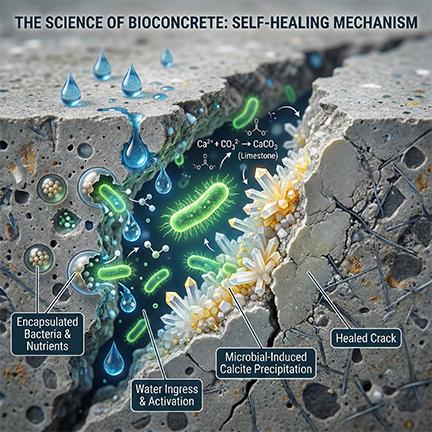
Some systems use microorganisms that produce mineral deposits when the right nutrients and environmental conditions are present. These deposits can help seal small cracks in cement-based materials. Other approaches investigate biological polymers or cell-based systems that respond to damage.
The main advantage is that a material could perform part of its own maintenance instead of relying entirely on external repair work.
Benefits and Hidden Risks
Self-healing materials may extend the service life of certain structures, reduce maintenance requirements, and limit material waste. Research into self-healing concrete has demonstrated several approaches, including bacterial mineralization and encapsulated healing agents.
However, healing performance depends on moisture, temperature, crack size, material composition, and the survival of biological components. A repaired crack does not automatically mean that the structure has regained its original strength. Engineers must verify performance before these materials can be trusted in critical infrastructure.
2. Living Materials Breakthroughs in Bacteria-Based Construction
Bacteria-based construction materials combine microbiology with engineering to create materials that can perform useful functions. Researchers are investigating how microorganisms can contribute to mineral formation, bind particles, and improve selected material properties.
One important research direction involves microbial mineralization, in which microorganisms help promote the formation of solid minerals. This process may be useful in crack sealing, soil stabilization, and certain construction applications.
Why Bacteria-Based Materials Matter
Traditional construction materials often depend on energy-intensive manufacturing processes and substantial raw-material consumption. Biological approaches may provide alternative methods for producing or repairing specific building components.
For example, bacterial systems designed for self-healing concrete may help deposit calcium carbonate within small cracks. This could reduce water penetration and protect reinforcing materials from some forms of deterioration.
Limitations of Bacterial Construction
Bacteria-based materials must remain effective under changing environmental conditions. Some microorganisms may become inactive when temperatures, moisture levels, or nutrient availability change. Researchers must also evaluate durability, production costs, biological safety, and compatibility with existing construction practices.
These materials are not a universal replacement for conventional concrete. Their potential depends on whether they can meet engineering standards and perform reliably over long periods.
3. Living Materials Breakthroughs in Fungal Materials and Sustainable Packaging
Fungi are attracting interest as a source of sustainable materials. Certain fungi produce networks of microscopic filaments called mycelium, which can bind agricultural residues and other organic particles into lightweight structures.
Mycelium-based materials are being explored for packaging, insulation, interior products, and other applications where conventional plastics or synthetic foams may be replaced by alternatives with lower environmental impacts.
How Mycelium Materials Are Developed
Researchers and manufacturers can grow fungal networks on suitable organic substrates. As the network develops, it binds the surrounding material into a coherent structure. The resulting material can then be processed and dried to achieve desired characteristics.
The properties depend on the fungal species, substrate, growing conditions, and finishing process. These factors influence density, strength, water resistance, and insulation performance.
Environmental Benefits and Risks
Fungal materials may use agricultural by-products and can reduce reliance on some petroleum-based materials. Depending on their composition and treatment, certain products may also be biodegradable.
Nevertheless, biodegradability is not guaranteed under every environmental condition. Coatings, adhesives, additives, and mixed-material construction can make disposal more complicated. Moisture sensitivity, fire performance, consistency, and durability also require careful testing before wider use.
4. Living Materials Breakthroughs in Pollution Detection
Living materials may provide new ways to detect harmful substances in water, soil, and air. Researchers are investigating biological sensing systems that respond to selected chemicals or environmental signals and produce a measurable output.
These systems can combine living cells with materials that support them and help translate biological activity into a visible, electrical, or otherwise detectable signal.
How Living Sensors Detect Contamination
A biological sensor may respond to a particular pollutant by changing its activity or producing a signal. Researchers can design the surrounding material to help maintain the biological component and make the response easier to measure.
Potential applications include environmental monitoring, industrial process control, and detecting changes in water quality. In some settings, living sensors could complement conventional analytical instruments.
Risks of Living Detection Systems
Biological sensors may respond differently to temperature, acidity, humidity, and other environmental factors. A signal may also be influenced by substances other than the target pollutant.
For this reason, living sensors require calibration and validation against reliable testing methods. Researchers must also consider containment, biological stability, and the consequences of inaccurate readings. These systems should not replace established safety testing without sufficient evidence.
5. Living Materials Breakthroughs in Environmental Cleanup
Environmental cleanup is another promising application of living materials. Certain bacteria, fungi, and other organisms can transform, absorb, or break down specific pollutants under suitable conditions. Researchers are exploring ways to combine these biological capabilities with material structures that make treatment more controlled and efficient.

This research is relevant to contaminated soil, industrial wastewater, and some forms of chemical pollution. The exact application depends on the pollutant and the biological system involved.
How Bioengineered Materials May Help
Living materials may provide a stable environment for useful microorganisms while bringing them into contact with targeted contaminants. Some systems are designed to retain biological activity in a specific location, allowing treatment to occur without distributing organisms freely throughout the environment.
In principle, these approaches could support localized remediation and reduce the need for some resource-intensive treatment methods.
Environmental Safety Challenges
Not every pollutant can be safely broken down by biological systems. Some processes may create intermediate substances that require additional treatment, while others work only within a limited range of conditions.
Researchers must assess the fate of contaminants, the stability of the material, and the possibility of unintended biological release. Environmental monitoring and appropriate containment are particularly important when engineered organisms are involved.
6. Living Materials Breakthroughs in Programmable Materials
Programmable living materials are designed to respond to specific conditions or signals. Instead of remaining completely passive, they may change their biological activity when exposed to particular chemicals, temperatures, or environmental cues.
Researchers can combine synthetic biology with material engineering to develop systems whose functions are more predictable and controllable. Potential applications include responsive coatings, environmental sensors, and materials that release or produce useful substances under selected conditions.
Why Programmable Materials Are Different
Conventional smart materials may respond to heat, pressure, or electricity through physical or chemical changes. Living materials add biological processes that can potentially provide more complex responses.
For instance, a research system could be designed to produce a detectable signal when it encounters a target substance. Another might alter its biological activity in response to a controlled environmental cue.
Challenges in Programming Living Systems
Living systems are complex. Their behaviour can change as cells grow, nutrients become limited, or environmental conditions fluctuate. A response that works in a laboratory may not remain equally reliable outdoors or at industrial scale.
Researchers must investigate long-term stability, unintended changes, containment, and whether the material can be safely deactivated when necessary. Programmability creates new opportunities, but it also increases the importance of careful biological design.
7. Living Materials Breakthroughs in Healthcare
Living materials are being investigated for healthcare applications, including tissue engineering, wound care, and controlled delivery of biological substances. Some approaches combine living cells with supportive biomaterials to create environments that interact with biological tissues.
These systems may eventually help researchers develop materials that support healing, respond to local conditions, or provide useful biological functions.
Potential Medical Applications
In tissue engineering, materials can provide a structure that helps cells attach, grow, and organize. Other research explores living systems that produce therapeutic substances or respond to signals associated with a particular biological environment.
Living materials may also contribute to specialized wound-care technologies, although any clinical application must meet strict requirements for safety, effectiveness, and quality control.
Medical Risks and Limitations
Living medical materials introduce challenges beyond those associated with ordinary implants or dressings. Researchers must consider immune responses, contamination, cell survival, unwanted biological activity, and the possibility of unexpected effects.
A promising laboratory result does not establish that a treatment is safe or effective for patients. Clinical testing and regulatory review remain essential before new living-material technologies can become routine medical products.
8. Living Materials Breakthroughs in Photosynthetic Materials
Photosynthetic living materials incorporate organisms such as algae or other photosynthetic cells into material structures. These organisms use light to support biological processes and, in some systems, can contribute to carbon uptake or the production of useful compounds.
Scientists are exploring whether photosynthetic materials could be integrated into building components, environmental systems, and specialized biotechnological devices.
How Photosynthetic Materials Work
The material provides a suitable environment for living cells, while light supports photosynthesis. Depending on the design, researchers may investigate carbon uptake, oxygen production, or the generation of biological products.
Potential uses include research-scale building panels, environmental monitoring systems, and applications where biological activity is valuable.
Benefits and Hidden Risks
Photosynthetic materials may provide functions that conventional materials cannot easily perform. They could potentially combine structural or protective roles with selected biological functions.
However, these systems require appropriate light, water, nutrients, and temperature conditions. Their performance may change with the seasons, and long-term maintenance can be complicated. Researchers must also evaluate durability, water leakage, biological containment, and the overall environmental footprint before large-scale adoption.
Conclusion: Living Materials Breakthroughs Offer Hope and Risks
Living Materials Breakthroughs are creating new possibilities at the intersection of biology, engineering, and materials science. Self-healing systems may help repair certain types of damage, fungal materials could offer alternatives for selected packaging applications, and living sensors may improve environmental monitoring. Other research explores pollution treatment, programmable biological responses, healthcare materials, and photosynthetic systems.
Despite this promise, living materials remain a developing field. Their performance depends on biological stability, environmental conditions, production methods, and the specific task they are designed to perform. Safety, cost, durability, and regulatory requirements will influence how quickly these technologies can move from laboratories into everyday use.
The most practical future is likely to involve carefully selected applications rather than replacing every conventional material with a living alternative. Continued research, independent testing, responsible engineering, and transparent safety standards will help determine where living materials can deliver genuine benefits.
In 2026, the central opportunity is to learn how biological systems can make materials more adaptive and sustainable without overlooking the risks. With thoughtful development, living materials could become an important part of future construction, manufacturing, healthcare, and environmental protection.