Introduction: Why Animal Intelligence Discoveries Matter in 2026
Animal Intelligence Discoveries are changing how scientists understand the minds, emotions, communication, and problem-solving abilities of animals. For many years, researchers studied intelligence mainly through human behaviour, but modern research shows that different species possess different kinds of cognitive abilities. Crows can solve complex problems, dolphins use sophisticated communication, elephants demonstrate remarkable social behaviour, and octopuses can navigate challenging environments.
In 2026, animal intelligence research continues to explore how animals learn, remember, cooperate, recognize individuals, and respond to their surroundings. Scientists are using behavioural experiments, brain imaging, bioacoustics, artificial intelligence, and long-term wildlife observations to investigate these abilities. These studies may help improve animal welfare, protect endangered species, and reveal new information about the evolution of intelligence.
However, these discoveries also raise important questions. Can human researchers accurately interpret animal emotions? Could advanced monitoring technologies disturb wildlife? And how should people use knowledge about animal intelligence without exploiting the animals being studied?
This article explores eight powerful Animal Intelligence Discoveries, explaining their scientific importance, potential benefits, and hidden risks. By understanding these findings, we can develop a more informed perspective on animal minds and the responsibilities humans have toward other species.
Table of Contents
- Animal Intelligence Discoveries in Crow Problem-Solving
- Dolphin Communication and Social Intelligence
- Elephant Memory and Emotional Behaviour
- Octopus Intelligence and Adaptability
- Animal Intelligence Discoveries in Tool Use
- Social Learning and Cultural Behaviour
- Animal Emotions and Empathy
- AI and Animal Communication Research
- Benefits and Hidden Risks
- The Future of Animal Intelligence Research
1. Animal Intelligence Discoveries: Crow Problem-Solving
Crows and other members of the corvid family are among the most extensively studied intelligent birds. Research has shown that some corvid species can solve multi-step problems, use tools, remember important locations, and adjust their behaviour according to previous experiences.

These abilities challenge the traditional assumption that sophisticated problem-solving requires a large mammalian brain. Bird brains differ structurally from mammalian brains, yet some birds demonstrate impressive cognitive performance.
How Crows Solve Complex Problems
In laboratory experiments, certain crows have selected tools, modified objects, or completed sequences of actions to obtain food. Some species can also remember human faces associated with threatening or harmless experiences.
Researchers investigate whether these behaviours reflect planning, learning, flexible decision-making, or combinations of several cognitive processes. A bird that completes a difficult task may be using experience and trial-and-error learning rather than the same reasoning process a human would use.
Benefits and Hidden Risks
Understanding crow intelligence can improve conservation practices and help scientists investigate how advanced cognition evolved. It may also encourage people to reconsider the mental abilities of animals commonly dismissed as ordinary pests.
However, experimental results must be interpreted carefully. Success on one task does not prove that every crow possesses identical abilities or understands a problem in a human-like way. Researchers should avoid making broad conclusions from a small number of animals or experiments.
2. Animal Intelligence Discoveries: Dolphin Communication and Social Intelligence
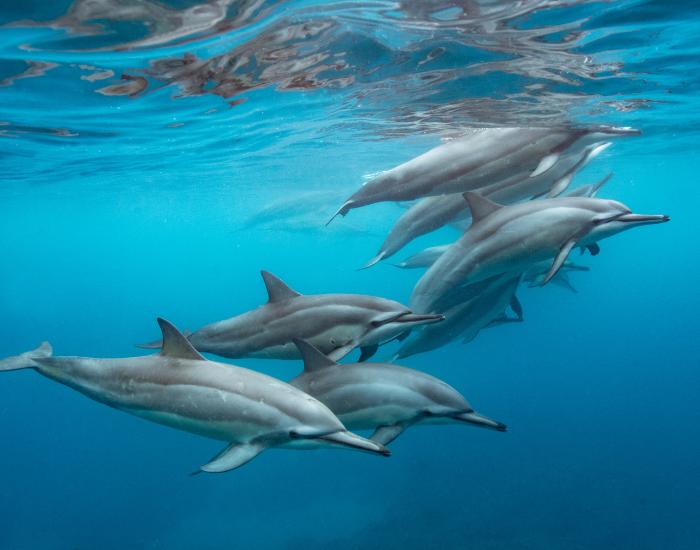
Dolphins are known for their complex social relationships, cooperative behaviour, and varied vocalizations. Researchers have studied how dolphins use whistles, clicks, body movements, and other signals to coordinate activities and maintain social connections.
Some bottlenose dolphins develop distinctive signature whistles that function in ways resembling individual identification signals. Dolphins may also remember familiar individuals and coordinate with partners during particular tasks.
What Dolphin Communication Reveals
Scientists study dolphin sounds to understand how information travels through underwater social groups. Acoustic recordings can help researchers identify vocal patterns, investigate changes in communication, and examine how dolphins respond to familiar members of their group.
Dolphins also cooperate in activities such as hunting. Their ability to coordinate movements and respond to social partners provides important evidence about flexible behaviour in marine mammals.
Benefits and Hidden Risks
Research into dolphin communication may improve conservation planning, help identify important habitats, and support better protection against underwater noise pollution.
Nevertheless, dolphin vocalizations are not fully understood. Researchers cannot assume that every sound has a direct translation into human language. Boat noise, sonar, and intrusive research methods may also disrupt natural behaviour. Responsible research should minimize disturbance and distinguish confirmed findings from interpretations that remain uncertain.

3. Animal Intelligence Discoveries: Elephant Memory and Emotional Behaviour
Elephants possess large brains, complex social structures, and impressive abilities to learn from experience. Researchers have documented their recognition of familiar individuals, responses to social separation, coordinated group behaviour, and sensitivity to changes within their surroundings.
Memory can be especially important for animals that live in environments where food, water, and safety vary across seasons. Remembering locations and recognizing other elephants may support survival and social stability.
How Elephant Memory Supports Survival
Elephants can travel long distances to reach resources. Experience may help them navigate familiar landscapes, respond to environmental changes, and maintain relationships with other members of their social groups.
Researchers also study elephant behaviour around injured or dead companions. Some observations suggest that elephants respond strongly to these situations, although the precise nature of their emotional experiences remains difficult to establish.
Hope and Hidden Risks
Understanding elephant cognition can strengthen arguments for protecting migration routes, family groups, and habitats. It may also help improve welfare standards in captivity and tourism.
However, emotional behaviour should not automatically be interpreted as identical to human grief or understanding. Scientists need systematic observations and careful comparisons before drawing conclusions. Conservation policies must also account for the practical challenges of protecting elephants in landscapes shared with people.
4. Animal Intelligence Discoveries: Octopus Intelligence and Adaptability
Octopuses demonstrate remarkable learning and problem-solving abilities despite having a nervous system organized very differently from that of humans. A large proportion of their neurons are distributed throughout their arms, allowing their nervous systems to process information in ways that differ from the centralized organization found in many vertebrates.
Researchers have observed octopuses exploring unfamiliar objects, navigating mazes, opening containers, and changing strategies when circumstances change.
Why Octopus Intelligence Is Different
Octopuses can investigate objects through touch and sight, learn from experience, and respond flexibly to their surroundings. Their ability to manipulate objects and explore confined spaces makes them valuable subjects for studying the evolution of intelligence.
Because octopuses evolved along a different evolutionary path from mammals, their cognitive abilities offer a useful comparison for understanding how complex behaviour can emerge in different nervous systems.
Benefits and Hidden Risks
Octopus research may reveal new principles for adaptive robotics, flexible control systems, and problem-solving technologies. It also contributes to growing discussions about the welfare of invertebrates.
The main challenge is interpreting their behaviour without assuming that their minds work like human minds. Captive conditions, handling, and repeated experiments can also affect their behaviour. Researchers should provide appropriate environments and follow relevant animal-welfare standards.
5. Animal Intelligence Discoveries: Tool Use Across Species
Tool use is one of the clearest examples of flexible animal behaviour. Several species use objects to obtain food, reach otherwise inaccessible resources, or complete tasks that would be difficult without assistance.
Chimpanzees use sticks to extract insects and may use stones to crack nuts. Some sea otters use rocks to open hard-shelled prey, while particular bird species use tools to reach food hidden in narrow spaces.
How Scientists Study Animal Tool Use
Researchers investigate whether animals select tools according to the task, modify objects, learn techniques from others, or adapt their methods when circumstances change.
These behaviours can reveal how animals combine observation, memory, physical skills, and previous experience. Comparing tool use across species also helps scientists investigate whether similar cognitive abilities evolved independently.
Benefits and Hidden Risks
Studying animal tool use can improve understanding of intelligence, evolution, and learning. It can also highlight the importance of preserving habitats that provide animals with suitable materials and opportunities to develop natural behaviours.
However, tool use does not necessarily prove that an animal understands a task in exactly the same way a human would. Researchers must consider individual differences, environmental conditions, and learning histories before interpreting a behaviour as evidence of advanced reasoning.
6. Animal Intelligence Discoveries: Social Learning and Animal Culture
Animals do not always learn independently. In many species, individuals acquire behaviours by observing or interacting with others. This process, known as social learning, can help useful behaviours spread through a group.
Researchers have investigated social learning in primates, whales, dolphins, birds, and other animals. Examples include learned feeding techniques, regional vocal patterns, migration-related behaviours, and distinctive ways of using tools.
How Animal Culture Develops
When a behaviour spreads through social interaction and persists within a group, scientists may investigate whether it represents a cultural tradition. Some whale populations, for example, exhibit vocal patterns that change over time and can spread among individuals.
Chimpanzee communities may also differ in their customary tool-use behaviours. These differences help researchers investigate the role of learning and social relationships in shaping animal behaviour.
Hope and Hidden Risks
Social learning research may improve conservation efforts by identifying how important behaviours are transmitted between generations. Protecting experienced individuals and stable social groups can sometimes help preserve knowledge within animal populations.
However, distinguishing culture from genetic differences or environmental influences can be difficult. Researchers need long-term evidence to establish how a behaviour originated and spread. Human disturbance can also disrupt social networks and interfere with learning opportunities.
7. Animal Intelligence Discoveries: Emotions, Empathy, and Cooperation
Animal emotions are an important area of scientific investigation. Researchers study how animals respond to separation, danger, social conflict, cooperation, and the distress of other individuals.
Certain species demonstrate behaviours that may indicate social sensitivity. Elephants sometimes respond to distressed companions, primates may provide reassurance after conflicts, and rats have displayed helping behaviours in experimental settings.
What Animal Behaviour Can Tell Us
Scientists use behavioural observations and controlled experiments to investigate whether animals recognize distress, change their actions according to another individual’s condition, or cooperate to achieve shared goals.
These studies help researchers examine the relationship between emotion, social learning, and decision-making. They also encourage more careful consideration of how animals experience their environments.
Hidden Risks of Interpreting Animal Emotions
Behaviour alone cannot always reveal an animal’s internal emotional state. A response that appears compassionate to humans may have several possible explanations, including learned behaviour, social bonding, or a response to environmental cues.
Researchers must avoid treating human interpretations as established scientific facts. At the same time, uncertainty about the precise nature of animal emotions does not mean that animal welfare can be ignored.
Evidence-based welfare practices should take account of species-specific needs, stress responses, social relationships, and opportunities to express natural behaviours.
8. Animal Intelligence Discoveries: AI and Animal Communication Research
Artificial intelligence is creating new ways to analyze animal sounds, movements, and behavioural patterns. Researchers can use machine-learning systems to examine large collections of recordings that would be difficult to analyze manually.
AI-assisted research is being applied to birdsong, whale vocalizations, dolphin communication, and other forms of animal signalling. These tools may help identify repeated patterns, classify sounds, and investigate how communication changes across individuals or environments.
How AI Helps Decode Animal Signals
A machine-learning model can compare thousands of recordings and identify acoustic similarities that researchers might otherwise overlook. Scientists can then test whether particular patterns are associated with species, social contexts, or specific behaviours.
AI can also support wildlife monitoring by detecting animal calls in large acoustic datasets. This can make it easier to study elusive species without repeatedly capturing or approaching them.
Hope and Hidden Risks
AI may accelerate discoveries about animal communication and improve conservation monitoring. However, detecting a repeated sound pattern does not automatically reveal its meaning.
Models can produce inaccurate classifications, and biased datasets may overlook less frequently recorded species or behaviours. Researchers must validate findings with independent observations and avoid claiming that AI has translated an animal language unless the evidence supports that conclusion.
Privacy is not the only concern in wildlife monitoring: recordings and location data can also reveal the whereabouts of endangered animals to people who may disturb or exploit them. Data protection and responsible sharing are therefore important.
Conclusion: Animal Intelligence Discoveries Offer Hope and Risks
Animal Intelligence Discoveries are transforming scientific understanding of how animals learn, remember, communicate, cooperate, and respond to their environments. Crow problem-solving, dolphin communication, elephant memory, octopus adaptability, tool use, social learning, emotional behaviour, and AI-assisted communication research all reveal different aspects of animal cognition.
These discoveries can support wildlife conservation, improve animal welfare, and help scientists understand the evolution of intelligence. They may also inspire advances in robotics, artificial intelligence, and adaptive technology.
Nevertheless, researchers must be careful not to exaggerate findings or interpret every animal behaviour through a human perspective. Advanced monitoring systems also require responsible use, and scientific studies should minimize stress and disturbance to the animals involved.
The most valuable progress will come from combining rigorous experiments with long-term observation and ethical research practices. By studying animals with curiosity and respect, scientists can expand our understanding of intelligence while helping protect the remarkable diversity of life on Earth.