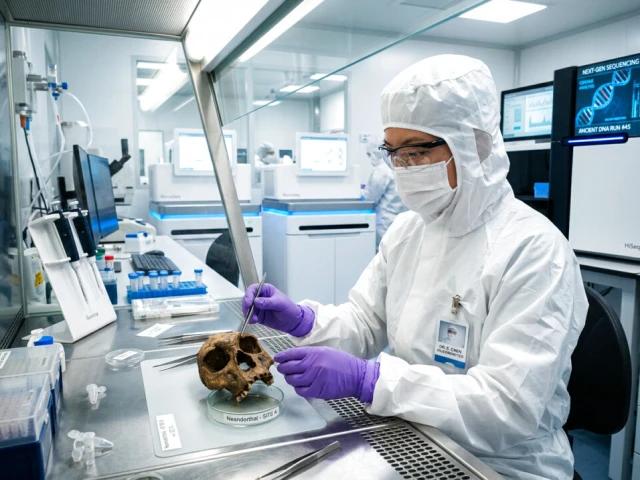
Ancient DNA Discoveries are transforming how scientists investigate human origins, extinct animals, ancient diseases, and lost civilizations. In 2026, researchers continue to improve the methods used to recover and analyze genetic material from ancient bones, teeth, sediments, and archaeological remains. These discoveries can reveal information that traditional historical records and fossil studies cannot provide on their own.
Ancient DNA, often called aDNA, is genetic material preserved in biological remains over long periods. By comparing ancient genetic sequences with those of living organisms, scientists can investigate migration, evolution, population relationships, and changes in biodiversity. Some studies also reveal how ancient pathogens spread and how humans adapted to changing environments.
However, Ancient DNA Discoveries come with important limitations. DNA breaks down over time, samples can become contaminated, and genetic findings may be misunderstood when separated from archaeological evidence. Ethical questions also arise when researchers study human remains or genetic information connected to living communities.
This article explores eight important areas of ancient DNA research, highlighting their scientific potential, possible benefits, and hidden risks.
Table of Contents
- Ancient DNA Discoveries About Human Origins
- Ancient DNA Discoveries About Lost Civilizations
- Ancient DNA Discoveries About Extinct Animals
- Ancient DNA Discoveries About Ancient Diseases
- Ancient DNA Discoveries About Human Migration
- Ancient DNA Discoveries About Ancient Diets
- Ancient DNA Discoveries About Climate and Ecosystems
- Ancient DNA Discoveries Using Sediment DNA
- Ancient DNA Discoveries Comparison Table
- Ancient DNA Discoveries: Hope and Hidden Risks
- Conclusion
1. Ancient DNA Discoveries About Human Origins
One of the most fascinating areas of Ancient DNA Discoveries involves the history of human evolution. Genetic analysis of ancient human remains has helped researchers understand relationships between modern humans, Neanderthals, and Denisovans. These ancient human groups were not completely isolated from one another. Evidence shows that interbreeding occurred between some populations.

Scientists can identify inherited genetic segments that entered modern human populations through these ancient encounters. Researchers have also investigated how certain inherited variants may have influenced adaptation to different environments.
Hope Behind Ancient DNA Discoveries About Human Origins
Ancient genetic evidence helps scientists reconstruct parts of human history that cannot be understood from fossils alone. It can reveal population relationships, periods of interbreeding, and genetic diversity that existed thousands of years ago.
Hidden Risks of Ancient DNA Discoveries About Human Origins
Genetic relationships do not provide a complete account of someone’s identity, culture, or language. Ancient samples may represent only a small part of a population, and poorly supported interpretations can create misleading stories about ancestry. Researchers must combine genetics with archaeology and other evidence.
2. Ancient DNA Discoveries About Lost Civilizations
Ancient DNA can help researchers investigate how people lived, moved, and interacted in historical societies. Genetic evidence recovered from archaeological remains may reveal whether a settlement included people with different ancestral backgrounds or whether populations changed over generations.
These findings can contribute to the study of trade, migration, family relationships, and population decline. When genetic data are combined with inscriptions, burial practices, artifacts, and historical records, researchers can develop a more detailed picture of ancient communities.
Hope Behind Ancient DNA Discoveries About Lost Civilizations
DNA analysis can challenge assumptions that ancient populations were genetically uniform or completely isolated. It can also help researchers investigate connections between archaeological sites and movements of people across regions.
Hidden Risks of Ancient DNA Discoveries About Lost Civilizations
Genetic similarities do not automatically establish a civilization’s language, political identity, or cultural traditions. Modern national and ethnic categories may not fit ancient societies. Researchers should avoid assigning a single identity to an entire population based on a limited number of samples.
Picture 1 placement: Add a realistic image of archaeologists examining ancient human remains at an archaeological excavation site.
3. Ancient DNA Discoveries About Extinct Animals
Ancient DNA has transformed the study of extinct and endangered animals. Genetic material recovered from bones, teeth, preserved tissues, and other remains can reveal relationships between species and changes in their populations over time.
Researchers have used ancient genetic evidence to study mammoths, ancient horses, wolves, and many other animals. By comparing DNA from different periods, scientists can examine population decline, genetic diversity, and the effects of changing habitats.

Hope Behind Ancient DNA Discoveries About Extinct Animals
These Ancient DNA Discoveries can help conservation scientists understand how species responded to past environmental changes. Genetic information may also help identify vulnerable populations and inform modern wildlife management.
Research into ancient genomes has contributed to discussions about de-extinction, the attempt to recreate certain characteristics of extinct species through biotechnology. However, producing an organism resembling an extinct animal is not the same as restoring the original species or its former ecosystem.
Hidden Risks of Ancient DNA Discoveries About Extinct Animals
De-extinction projects can be expensive and technically difficult. Reconstructed organisms may differ substantially from their extinct relatives, and releasing them could introduce ecological risks. Conservation efforts must also consider whether resources would be better spent protecting species and habitats that still exist.
4. Ancient DNA Discoveries About Ancient Diseases
Ancient DNA allows scientists to investigate pathogens that affected people in the past. Genetic material from ancient remains has helped researchers study the history and evolution of bacteria and other disease-causing organisms.
Such research can reveal how particular pathogens changed over time, how they spread between populations, and how historical outbreaks affected communities. These findings can provide context for understanding the long-term relationship between humans and infectious diseases.
Hope Behind Ancient DNA Discoveries About Ancient Diseases
Studying ancient pathogen genomes may help scientists understand how infectious organisms evolve and how past populations responded to disease. It can also clarify whether a pathogen found in historical remains was related to strains studied in later periods.
Hidden Risks of Ancient DNA Discoveries About Ancient Diseases
Ancient pathogen DNA is often fragmented and incomplete. Detecting a genetic sequence does not always prove that an organism was responsible for a person’s death or a population-wide outbreak. Researchers must use strict laboratory controls to prevent contamination and interpret findings alongside archaeological and medical evidence.
Ancient pathogen research also requires responsible communication. Discoveries should not be exaggerated into claims that a historical disease will inevitably return or that ancient DNA can predict the next pandemic.
5. Ancient DNA Discoveries About Human Migration
Human migration is another major focus of Ancient DNA Discoveries. Researchers can compare genetic material from people who lived in different places and periods to investigate how populations moved and mixed.
Ancient genomes have provided evidence of large-scale population movements across Europe, Asia, Africa, and other regions. In some cases, genetic research has changed earlier interpretations based mainly on artifacts or burial practices.
Hope Behind Ancient DNA Discoveries About Human Migration
Genetic studies can help researchers test hypotheses about population movements and relationships between ancient communities. When combined with archaeology and linguistic research, DNA can reveal complex patterns of migration rather than a simple story of isolated groups.
Hidden Risks of Ancient DNA Discoveries About Human Migration
Migration evidence can be misused to support modern political or ethnic claims. Genetic ancestry does not determine a person’s rights, nationality, culture, or personal identity. Researchers must distinguish between biological ancestry and social belonging while explaining the uncertainty in their findings.
6. Ancient DNA Discoveries About Ancient Diets
Scientists can investigate ancient diets through DNA preserved in archaeological materials. Genetic traces found in dental plaque, food residues, animal remains, and sediments may help identify plants, animals, and microorganisms associated with past food systems.
These techniques can complement traditional evidence such as pottery, cooking tools, plant remains, and animal bones. Together, they can reveal how people obtained food, managed animals, and adapted to local environments.
Hope Behind Ancient DNA Discoveries About Ancient Diets
Ancient DNA research can improve understanding of the development of agriculture, animal domestication, and historical food diversity. It may also help researchers trace changes in plant and animal populations associated with human settlement.
Hidden Risks of Ancient DNA Discoveries About Ancient Diets
DNA evidence does not always establish exactly what a person ate. Genetic material may come from environmental contamination or organisms unrelated to direct food consumption. Scientists need careful sampling methods and supporting evidence before making strong claims about ancient diets.
Picture 2 placement: Add a realistic image of scientists examining ancient seeds, animal bones, and archaeological food remains in a research laboratory.
7. Ancient DNA Discoveries About Climate and Ecosystems
Environmental DNA research helps scientists investigate organisms that once lived in particular places. Ancient genetic material recovered from lake sediments, caves, permafrost, and other environments can reveal past biodiversity.
These samples may contain traces of plants, animals, fungi, and microorganisms. By comparing genetic evidence from different layers of sediment, researchers can investigate how ecosystems changed alongside temperature shifts, habitat changes, and human activity.
Hope Behind Ancient DNA Discoveries About Climate and Ecosystems
Ancient DNA can extend our understanding of biodiversity beyond what visible fossils preserve. It may reveal the past presence of species that left few recognizable bones and help scientists reconstruct historical ecosystems.
This information can support conservation planning by showing how species distributions changed under different environmental conditions.
Hidden Risks of Ancient DNA Discoveries About Climate and Ecosystems
Environmental samples can contain DNA transported by water, wind, animals, or human activity. DNA may also persist in sediments for different lengths of time depending on local conditions. Researchers must consider these limitations before concluding that a species lived in a particular location during a specific period.
8. Ancient DNA Discoveries Using Sediment DNA
One important development in ancient genetic research is the analysis of DNA preserved directly in sediments. Scientists can sometimes recover genetic traces from archaeological sites and caves even when recognizable human or animal bones are absent.
Sediment DNA can help investigate which organisms occupied a location and how the biological community changed over time. In suitable circumstances, researchers can also identify genetic traces associated with ancient human populations.
Hope Behind Ancient DNA Discoveries Using Sediment DNA
This method expands the range of archaeological sites that scientists can study. It may provide information about past environments and populations when conventional fossil evidence is scarce.
Sediment analysis can also allow researchers to investigate ancient ecosystems without requiring large numbers of visible remains.
Hidden Risks of Ancient DNA Discoveries Using Sediment DNA
DNA can move between sediment layers or enter a site through later contamination. A genetic trace does not always prove that an organism lived directly at the sampling point. Accurate dating, careful sampling, laboratory controls, and independent evidence remain essential for reliable conclusions.
9. Ancient DNA Discoveries Comparison Table
The following table summarizes major research areas and their potential limitations.
| Research Area | Main Scientific Value | Key Limitation |
|---|---|---|
| Human origins | Reveals ancient genetic relationships | Limited samples |
| Lost civilizations | Investigates population connections | DNA cannot define culture |
| Extinct animals | Studies evolution and diversity | De-extinction remains challenging |
| Ancient diseases | Explores pathogen evolution | Incomplete genetic evidence |
| Human migration | Tests population movement theories | Ancestry can be misinterpreted |
| Ancient diets | Investigates historical food systems | Contamination and indirect evidence |
| Climate and ecosystems | Reconstructs past biodiversity | DNA movement between environments |
| Sediment DNA | Studies sites with few visible remains | Dating and contamination challenges |
10. Ancient DNA Discoveries: Hope and Hidden Risks
Ancient DNA Discoveries provide powerful ways to investigate the past, but their value depends on scientific quality and responsible interpretation. Better sequencing methods and laboratory techniques may allow researchers to recover useful information from increasingly difficult samples. Nevertheless, not every ancient sample contains enough DNA for reliable analysis.
Ancient DNA Discoveries and Scientific Accuracy
Researchers must distinguish direct genetic evidence from interpretations built around it. Reliable studies use contamination controls, appropriate statistical methods, and comparisons with archaeological or environmental evidence. Findings should also be explained with suitable uncertainty rather than presented as unquestionable facts.
Ancient DNA Discoveries and Ethical Responsibility
Human remains can hold deep cultural, spiritual, and historical significance. Researchers should consider the wishes of descendant communities, relevant laws, and appropriate consultation before collecting or analyzing samples. Privacy concerns may also arise when ancient genetic information is connected to living populations.
Responsible research should communicate why a study is being conducted, how samples will be used, and what limitations apply. These safeguards help balance scientific discovery with respect for people and their heritage.
Ancient DNA Discoveries and Future Technology
Improved DNA sequencing, computational analysis, and contamination detection may expand what scientists can learn from ancient material. However, advanced technology cannot automatically solve problems caused by damaged DNA, missing samples, or uncertain archaeological context.
The strongest results will come from combining genetic evidence with archaeology, anthropology, ecology, and other scientific disciplines.
Conclusion: The Future of Ancient DNA Discoveries
Ancient DNA Discoveries are reshaping our understanding of human evolution, migration, extinct animals, historical diseases, ancient diets, and changing ecosystems. They provide researchers with new ways to investigate questions that were once difficult or impossible to answer.
At the same time, ancient genetic evidence requires careful interpretation. Contamination, incomplete samples, ethical concerns, and misleading claims can weaken the value of otherwise promising research. Scientists must explain both what the evidence reveals and what remains uncertain.
The future of Ancient DNA Discoveries will depend not only on better technology but also on responsible research practices and collaboration with relevant communities. By combining genetic evidence with archaeological and environmental findings, researchers can uncover more of the past while avoiding unsupported conclusions.
These discoveries offer genuine hope for understanding the history of life on Earth, provided that scientific curiosity is balanced with evidence, transparency, and respect.