Introduction: Why Biodegradable Packaging Breakthroughs Matter in 2026
Biodegradable Packaging Breakthroughs are creating new opportunities to reduce dependence on conventional plastic packaging in 2026. Plastic is widely used to protect food, transport products, and prevent contamination, but poorly managed plastic waste can persist in the environment for many years. Scientists are therefore developing packaging materials made from renewable resources, agricultural waste, seaweed, fungi, and microorganisms.
Modern biodegradable packaging research goes beyond simply replacing plastic with natural materials. Researchers are working to improve strength, moisture resistance, food preservation, and safe disposal. Some experimental films can incorporate natural antimicrobial ingredients, while other materials may indicate changes in food freshness. These improvements could make biodegradable alternatives more useful for supermarkets, restaurants, food producers, and online businesses.
Recent scientific reviews published in 2026 highlight progress in biodegradable polymers, intelligent packaging, natural additives, and advanced material design. However, these technologies still face challenges involving production costs, food safety, durability, and the conditions needed for biodegradation. <Cite refs={[“turn397105search2″,”turn397105search3”]}/>
This article explores eight promising Biodegradable Packaging Breakthroughs, explaining how they work, their potential environmental benefits, and the hidden risks that must be addressed before widespread adoption.

Table of Contents
- Plant-Based Biodegradable Packaging Breakthroughs
- Seaweed-Based Packaging Breakthroughs
- Mycelium-Based Packaging Breakthroughs
- Agricultural Waste Packaging Breakthroughs
- Microbial Bioplastics Breakthroughs
- Edible Films and Protective Coatings
- Smart Biodegradable Packaging Breakthroughs
- Advanced Biodegradable Packaging Films
- Benefits and Hidden Risks
- The Future of Biodegradable Packaging
1. Biodegradable Packaging Breakthroughs in Plant-Based Materials
Plant-based polymers are an important area of biodegradable packaging research. Scientists are investigating materials derived from corn starch, potato starch, cellulose, and other renewable biological resources. These materials can be processed into films, trays, protective wrapping, and selected disposable products.
Starch-based packaging is especially interesting because starch is widely available and can be processed using established manufacturing techniques. However, starch alone may not provide all the properties required for commercial packaging. Researchers therefore combine it with other polymers, plasticizers, fibers, or protective coatings to improve performance.
How Plant-Based Packaging Works
Plant-derived materials contain natural polymers that can form films or molded structures under suitable processing conditions. Their final properties depend on the source material, formulation, manufacturing method, and intended use.
Some formulations are designed for dry products, while others are being developed for food applications that require better flexibility and resistance to moisture. Combining plant-based polymers with other biodegradable materials may help address weaknesses that would otherwise limit their usefulness.
Benefits and Hidden Risks
Plant-based packaging can reduce reliance on fossil-based raw materials when its ingredients are sourced responsibly. It may also support agricultural industries by creating additional markets for renewable resources.
However, renewable origin does not automatically mean that a material is biodegradable in every environment. Agricultural production can require land, water, fertilizer, and energy. Some plant-based materials also absorb moisture too easily or provide weaker protection than conventional plastic.
Researchers must evaluate the entire product, including manufacturing and disposal, rather than judging sustainability by its raw ingredients alone.
2. Biodegradable Packaging Breakthroughs in Seaweed-Based Materials
Seaweed is gaining attention as a potential source of packaging materials because it contains polysaccharides that can form films and coatings. Depending on the species and processing method, researchers can extract compounds such as alginate and carrageenan for use in biodegradable packaging applications.
Seaweed-based materials are being investigated for food wrapping, edible coatings, sachets, and other products where short-term protection is required. Their film-forming properties make them useful candidates for reducing certain types of conventional plastic packaging.
How Seaweed Packaging Can Protect Products
Extracted seaweed polymers can be formulated into thin films that provide a physical barrier around a product. Researchers can adjust the formulation to improve flexibility, strength, and selected barrier properties.
Some experimental films also incorporate natural compounds that may help slow oxidation or inhibit particular microorganisms. These functions could support food preservation, although effectiveness depends on the specific ingredients and food being packaged.
Hope and Hidden Risks of Seaweed Packaging
Seaweed can be cultivated without using agricultural land in the same way as many terrestrial crops, and some seaweed-based materials can biodegrade under suitable conditions. These properties make the technology promising for selected applications.
Nevertheless, many seaweed films are sensitive to moisture and may struggle to maintain their strength when exposed to wet foods. Production costs, extraction methods, supply consistency, and food-contact safety also require attention.
Seaweed packaging should therefore be matched to the product it is intended to protect rather than treated as a universal replacement for every plastic wrapper.

3. Biodegradable Packaging Breakthroughs Using Mycelium
Mycelium is the network of fine filaments produced by fungi. Researchers and manufacturers are using this natural network to bind agricultural residues into lightweight molded structures. The resulting materials are being explored for protective packaging, cushioning, insulation, and selected shipping applications.
Mycelium-based packaging is particularly interesting because it can use agricultural by-products such as plant fibers and other suitable organic residues. Instead of relying entirely on petroleum-based foam, manufacturers can grow a material into a desired shape.
How Mycelium Packaging Is Made
A suitable fungal culture is grown on a prepared substrate under controlled conditions. As the mycelium develops, its filaments bind particles together, forming a structured material. The growth process is then stopped, and the material is dried or otherwise processed to achieve the desired properties.
The density, strength, and performance of the finished product depend on the fungal species, substrate, growing conditions, and treatment method.
Benefits and Limitations of Mycelium
Mycelium packaging can offer a renewable alternative for selected protective applications. Its ability to use agricultural residues may also help create value from materials that would otherwise be discarded.
However, fungal packaging may be sensitive to moisture, and its performance can vary between production batches. Drying, quality control, transport, and manufacturing capacity can affect its cost and environmental footprint.
The material’s end-of-life performance also depends on coatings, additives, and disposal conditions. Mycelium-based packaging is promising, but its suitability must be tested for each application.
4. Biodegradable Packaging Breakthroughs From Agricultural Waste
Agricultural waste is another promising resource for sustainable packaging. Crop residues, rice husks, wheat straw, sugarcane bagasse, and other plant by-products contain fibers and natural polymers that can be processed into packaging materials.
Instead of treating all these residues as waste, manufacturers may be able to transform them into trays, molded containers, protective inserts, and paper-like packaging products.
How Agricultural Residues Become Packaging
Plant fibers can be separated, cleaned, processed, and formed into sheets or molded shapes. Depending on the application, manufacturers may combine them with biodegradable binders or coatings to improve water resistance and strength.
Sugarcane bagasse, for example, can be molded into food-service containers. Cellulose-rich residues can also contribute to paper-based packaging or reinforced biodegradable films.
Environmental Benefits and Hidden Risks
Using agricultural residues may reduce demand for virgin raw materials and create additional value for farming by-products. It can also support local manufacturing where suitable feedstocks are available.
Nevertheless, collecting and processing residues requires energy and water. Some agricultural waste is already needed to maintain soil quality or provide other useful products, so diverting too much of it may create unintended consequences.
Packaging performance also depends on the binders and coatings used. A fiber-based container is not automatically suitable for composting if it contains persistent additives or mixed materials that complicate disposal.
5. Biodegradable Packaging Breakthroughs in Microbial Bioplastics
Microorganisms can produce certain polymers that researchers are investigating as alternatives to conventional petroleum-based plastics. One important family is polyhydroxyalkanoates, commonly known as PHAs. Certain bacteria produce these polymers under suitable growth conditions, and the materials can then be extracted and processed.
Other biodegradable polymers, including polylactic acid (PLA), can be produced from renewable feedstocks through industrial processing. Their properties and disposal requirements differ, so they should not all be treated as interchangeable.
How Microbial Bioplastics Work
For PHA production, microorganisms are cultivated using suitable feedstocks and controlled fermentation processes. The polymer is recovered and processed into material that can be used for films, containers, or other products.
Researchers are exploring ways to improve production efficiency and use lower-cost feedstocks, including suitable organic by-products. These improvements could help make microbial bioplastics more commercially competitive.
Benefits and Hidden Risks
Some microbial bioplastics offer useful combinations of processability and biodegradation potential. Depending on their composition and conditions, they may be suitable for applications where conventional plastics create end-of-life problems.
However, production can remain expensive, and performance varies between polymer types. Some materials require industrial composting or other controlled conditions to break down effectively.
Manufacturers must also consider energy use, feedstock sourcing, contamination, and the infrastructure available to collect and process discarded packaging. Material selection should be based on verified performance and local waste-management capabilities.
6. Biodegradable Packaging Breakthroughs in Edible Films and Protective Coatings
Edible films and protective coatings are being developed to reduce the amount of conventional packaging required for certain foods. These thin layers can be made from food-compatible ingredients such as proteins, polysaccharides, and selected plant-derived compounds.
Unlike a traditional wrapper, an edible coating can be applied directly to the surface of a food product. Depending on its formulation, it may help slow moisture loss, oxidation, or other processes that contribute to quality deterioration.
How Edible Packaging Can Reduce Waste
Researchers are exploring edible films for products such as fruits, vegetables, and selected processed foods. Some formulations include natural compounds that may provide antioxidant or antimicrobial functions.
For example, a suitable coating on fruit could help slow moisture loss and maintain quality during storage. The result depends on the fruit, the coating composition, and the storage conditions.
Food Safety and Practical Challenges
Edible packaging must meet food-safety requirements and be appropriate for the intended food. Allergens, taste, texture, shelf stability, and possible interactions between the coating and food must be considered.
An edible film also cannot automatically replace a strong, sealed wrapper used to protect products during long-distance transport. Its role may be to complement existing packaging or reduce material use in specific applications.
Further testing is needed to confirm performance across different foods and supply chains.
7. Biodegradable Packaging Breakthroughs in Smart Packaging
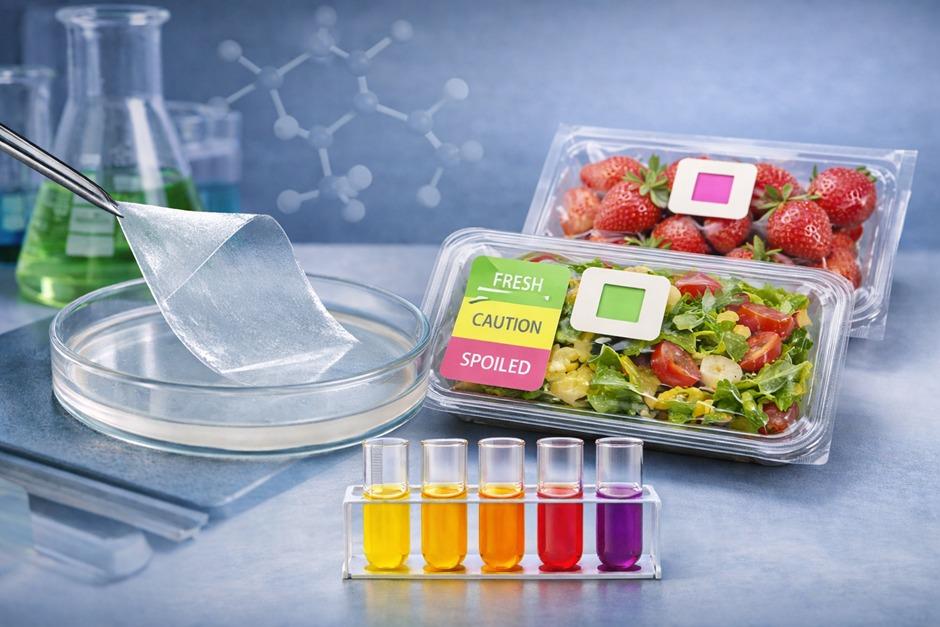
Smart packaging is designed to provide information about a product’s condition rather than simply containing it. Researchers are investigating biodegradable films with indicators that respond to changes associated with food spoilage, such as changes in acidity or the presence of certain volatile compounds.
Some experimental systems use natural pigments, including pigments derived from plants, to create visible colour changes under particular conditions.
How Smart Biodegradable Packaging Works
A responsive indicator can be incorporated into a packaging film or label. When the surrounding conditions change, the indicator may change colour or produce another measurable signal.
This information could help food producers, retailers, and consumers identify changes in product condition. It may also support better inventory management and reduce unnecessary food disposal.
Hope and Hidden Risks
Smart biodegradable packaging could combine waste-reduction goals with useful product information. Some designs may also help manufacturers monitor packaging performance during storage.
However, a colour-changing indicator is not automatically a reliable food-safety test. Temperature, humidity, lighting, and the food itself can affect the signal. A product may be unsafe even if an indicator does not show an obvious change.
Researchers must validate these systems for specific foods, ensure that food-contact materials are safe, and explain clearly what the indicator can and cannot tell consumers.
8. Biodegradable Packaging Breakthroughs in Advanced Films and Coatings
One of the biggest challenges for biodegradable packaging is matching the performance of conventional plastic. Food packaging often needs to resist moisture, limit oxygen exposure, maintain strength, and protect products from contamination.
Researchers are developing advanced films by blending biodegradable polymers, reinforcing materials with natural fibers, applying protective coatings, and adjusting the structure of packaging layers.
A 2026 review in Food Research International describes research into improved mechanical properties, barrier performance, antimicrobial features, and intelligent packaging functions. It also highlights remaining challenges involving energy use, end-of-life treatment, and regulation. <Cite refs={[“turn397105search2″,”turn397105search0”]}/>
How Advanced Packaging Films Improve Performance
Blending polymers can help combine useful properties from different materials. Natural fibers or selected fillers may improve strength, while surface treatments can help control the movement of water vapor or oxygen.
Researchers are also investigating multilayer structures that provide different functions in different parts of a package. The challenge is to maintain the benefits of each layer without making the finished product too difficult to recycle or biodegrade.
Benefits and Hidden Risks
Advanced films could expand the range of products that biodegradable packaging can safely protect. Better barrier performance may help reduce food spoilage, while stronger materials could reduce damage during shipping.
However, additional coatings and fillers may complicate the degradation process. Some materials may need specialized facilities, and the finished package must be assessed as a complete product rather than by testing each ingredient separately.
The most successful designs will balance performance, safety, manufacturing cost, and realistic disposal options.
Conclusion: Biodegradable Packaging Breakthroughs Offer Hope and Risks
Biodegradable Packaging Breakthroughs are creating new possibilities for reducing reliance on conventional plastic packaging in 2026. Plant-based polymers, seaweed films, mycelium structures, agricultural residues, microbial bioplastics, edible coatings, smart indicators, and advanced films each offer potential advantages for selected applications.
However, no single material is suitable for every product or environment. Moisture sensitivity, cost, food safety, production energy, and disposal infrastructure can all influence whether a packaging innovation delivers meaningful environmental benefits.
It is also important to distinguish biodegradable, compostable, and bio-based packaging. A material can come from renewable resources without being biodegradable, and a biodegradable product may require specific industrial conditions rather than breaking down quickly in soil, seawater, or a household compost bin.
The best path forward combines material innovation with responsible product design, verified environmental claims, and appropriate waste-management systems. By choosing packaging according to its actual performance and end-of-life requirements, businesses can make more informed decisions and help build a more sustainable packaging industry.